Good Google Ads management for a boating business connects a relevant search with an accurate ad, a useful landing page and a measurable commercial outcome. For a dealer, that might be a qualified viewing request. For a charter operator, it might be a booking. For a marine service business, it might be an enquiry within its working area.
Start by defining which enquiries matter, then build campaigns around the services, locations and inventory you can support. Judge progress through lead quality and sales outcomes alongside advertising metrics.
This guide covers Google Ads management for the boating industry, focusing on dealers, brokers, charter operators and marine services. If you sell products through an online checkout, our marine ecommerce paid advertising guide covers that journey.
Google Ads management for the boating industry: campaign choices
Keyword-based Search campaigns provide a practical starting point when you want to target specific demand, such as boat viewings, marina berths or engine servicing. Organise them around commercial differences that need separate budgets or messages. Within each campaign, group related keywords and ads by service or boat category.
For example, a dealer might separate new-boat enquiries from used-boat enquiries where stock, margins and priorities differ. Avoid creating so many campaigns that each receives too little budget to assess usefully.
Performance Max can serve across Google's channels, including Search, YouTube, Display and Maps. Google positions it as a complement to keyword-based Search, with sales and lead-generation applications. See Google's Performance Max guidance.
Consider testing it when you have dependable conversion measurement, suitable creative and a clear way to assess lead quality. Ask what additional demand it should reach and how the test will be judged. Automation still needs accurate offers, appropriate destinations and commercial oversight.
Choose keywords around the enquiry you want
Google Ads management for the boating industry starts with the work you want to win. These are illustrative starting points, not verified search-volume opportunities:
| Business | Example search theme | Relevant destination |
|---|---|---|
| Boat dealer | Used motor boats for sale in a named region | Current matching stock |
| Yacht broker | Sell my sailing yacht | Brokerage valuation enquiry |
| Charter operator | Private fishing charter from a named port | Relevant trip and availability page |
| Marine service business | Outboard servicing in a named area | Service details and booking enquiry |
For Google Ads for boat dealers, keep stock and advertised categories aligned. For brokers, distinguish people buying a yacht from owners looking to sell. For charters, separate materially different trips when they require different messages.
Choose match types deliberately. Exact match can include searches with the same meaning or intent; it does not restrict delivery to identical wording. Phrase and broad match allow different degrees of reach. Google explains keyword matching here.
Review available search-term data and build negative keywords around genuine mismatches. Possible candidates include employment searches, model boats or services you do not provide. Do not automatically exclude words such as “used”, “hire” or “repair”: their relevance depends on your business.
Negative match types behave differently from positive keywords, and exclusions do not automatically cover every close variant. Check Google's negative keyword guidance before applying a broad exclusion across the account.
Plan seasonality and budget pacing from your own demand
For Google Ads management for the boating industry, build a calendar from enquiry records, booking dates, stock arrivals and service capacity. Separate the date somebody researches from the date they intend to buy, visit or travel. A charter enquiry for a future trip needs different planning from an immediate repair request.
Avoid applying one seasonal pattern across every region or service. Use your own evidence to decide when demand changes and whether you can fulfil it.
Set a media budget separately from management fees and any website or creative work. Ask the manager to explain what the available spend can realistically test. Where funds are limited, consider concentrating on one priority service and location before expanding.
Google's average daily budget is an average, so spending can be higher or lower on individual days. Review projected monthly spend and the applicable limits rather than treating the daily setting as a fixed daily cap. Google explains average daily budgets and spending limits.
Agree who can change budgets, what approval is needed and when to review pacing. Assess qualified demand and operational capacity before increasing spend.
Measurement in Google Ads management for the boating industry
Define conversion actions before launch. Google Ads supports measurement of website actions, phone calls and offline outcomes, with configuration depending on the action and data source. Google's conversion measurement overview explains the options.
Create a measurement plan that distinguishes:
- Forms: completed enquiries, with successful submission tested rather than just button clicks.
- Calls: phone interactions, with a clear distinction between clicking a number and having a useful conversation.
- Bookings: confirmed reservations or appointments, separated from booking-page visits.
- Sales progress: qualified opportunities, completed viewings and won business recorded by the team.
Call measurement options depend on eligibility and implementation. Confirm what is available in your market and how calls will be assessed. Google documents call conversion requirements.
Where bookings happen through another provider, test the complete journey. Check for missing events and duplicate counting. Agree which actions should guide bidding and which are useful supporting observations.
A request for a viewing and a confirmed boat sale represent different stages. Keep that distinction in reports, and feed the sales team's assessment back into campaign decisions. Our marine advertising analytics guide covers the wider measurement topic.
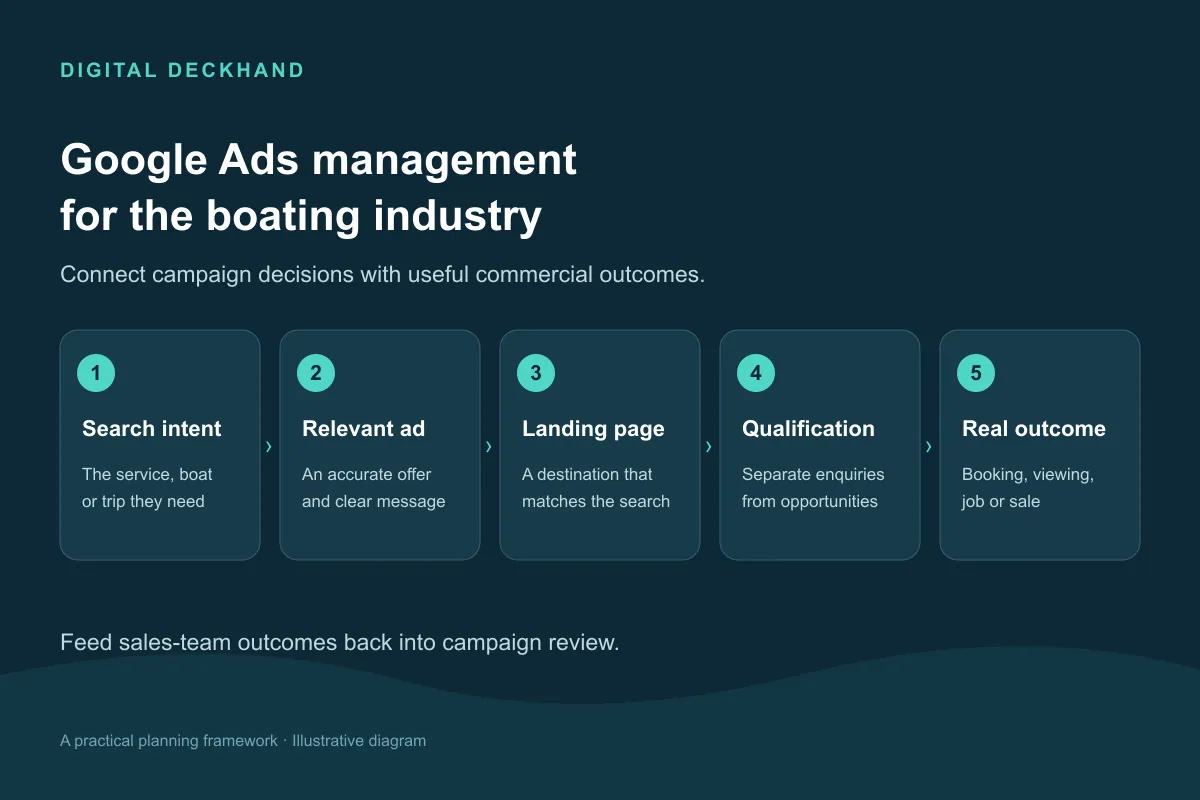
Measurement journey: search → relevant ad → matching landing page → call, form or booking → qualification → viewing, job or sale. Feed sales-team outcomes back into campaign review.
Match the landing page to the ad
Landing pages are part of Google Ads management for the boating industry: send visitors to the page that best answers the advertised search. An ad for a specific boat should lead to that boat or clearly matching stock. A berth enquiry should reach relevant marina information. A fishing-charter ad should explain the advertised trip and departure point.
Before sending traffic, check that the page answers practical questions:
- What is available, and where?
- Does the boat, trip or service fit the visitor's needs?
- Is the information current?
- What happens after an enquiry?
- Can the visitor call, submit a form or book easily on mobile?
Ask only for information you need to handle and qualify the enquiry. Test forms, phone links and booking tools on real devices. Assign responsibility for updating pages when a boat sells or availability changes.
If the journey needs broader attention, explore conversion rate optimisation. Confirm whether landing-page work is included in the advertising engagement or requires separate scope.
Questions to ask an agency before hiring
When comparing Google Ads management for the boating industry, ask for a clear explanation of the work and its purpose:
- What will you prioritise? Which services, locations and enquiry types will receive attention first?
- Why this campaign mix? What role will Search or Performance Max play, and how will you evaluate it?
- What counts as a useful conversion? How will you distinguish enquiries from qualified opportunities?
- What is included? Clarify tracking, ad copy, creative, landing pages, reporting and ongoing optimisation.
- Who controls the account? Confirm ownership, access, billing, budget approvals and handover arrangements.
- How will we review progress? Ask for reporting that connects spend and enquiries with lead quality, limitations and next actions.
Your team also needs responsibilities: responding to leads, maintaining availability and recording outcomes. Agree these before launch so both sides know what information is needed to make decisions.
Frequently asked questions
How much should a boating business spend on Google Ads?
There is no single suitable budget. Start with your service area, demand, commercial priorities and ability to handle enquiries. Ask for a focused test plan with assumptions stated clearly. Keep media spend separate from management and supporting work.
Is Performance Max better than Search for marine businesses?
Choose according to the job the campaign needs to do. Search can support a focused keyword-led plan; Performance Max offers broader channel coverage. Compare qualified outcomes against an agreed objective before deciding where to invest further.
How soon can we judge whether campaigns are working?
Check tracking, ad accuracy and enquiry handling from launch. Commercial evaluation needs enough relevant activity and time for leads to progress. Agree a review window around your sales or booking journey rather than expecting a universal deadline.
Can a small local marine service business run Google Ads?
Consider whether there is relevant demand, a workable service area and capacity to respond. A tightly scoped campaign may be worth assessing. Ask for the reasoning behind targeting choices and a practical way to judge the resulting enquiries.
Google Ads management for the boating industry with Digital Deckhand
Digital Deckhand is a marine-specialist, data-driven agency working with businesses including boat dealers, yacht brokers, marinas and charter operators.
Its bespoke paid advertising service covers Google Ads, Meta and TikTok. Scope can include strategy, tracking setup, campaign build and management, ad copy, hands-on creative production from client-supplied assets, optimisation and reporting. The platform mix should follow the agreed brief.
Landing-page input and optimisation can be included where agreed; they are not assumed in every paid-advertising engagement. Scope and pricing are bespoke, and commercial outcomes are not guaranteed.
To discuss marine Google Ads for your business, book a discovery call through our paid advertising enquiry page. Bring your priority services, target locations and current enquiry challenges.